Deep-rooted salt stocks and pillows
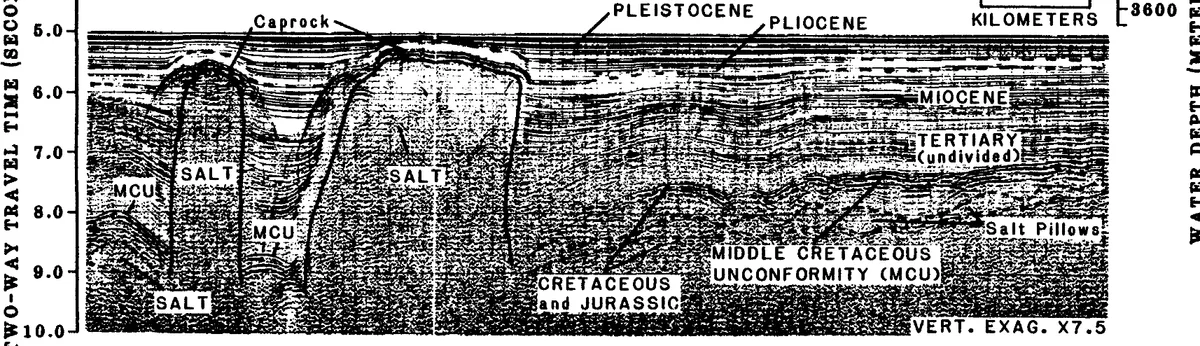
Two caprock-topped salt stocks rise from deep salt; older beds turn up on their flanks.
Image: U.S. Geological Survey Open-File Report 81-265 (R.B. Powers, editor, 1981), part of figure 19; seismic data acquired by the University of Texas Marine Science Institute. Public domain. Cropped and resized only. Source report (opens in a new tab)
Read the case
Two salt stocks rise from the deep salt source to just below the sea floor: a narrow one with a rounded top and a broad one with a flat crest, both capped by caprock. Older beds bend up against their flanks, a regional unconformity cuts across them, and the younger beds drape both crests. Low salt pillows lie to one side. The vertical scale is two-way travel time, exaggerated about 7.5 times.
How this preset was built from this image
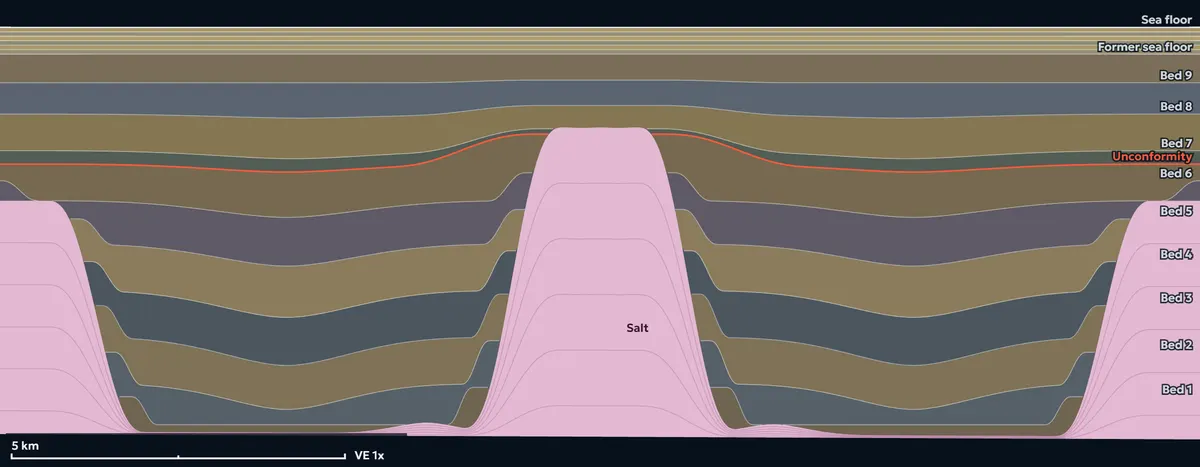
The two stocks keep the image's order, their rough spacing and their relative widths: a narrow stock and a broad, flat-crested one, both rooted in a source about 6 km deep. The three oldest beds use the flank-upturn shape, so they climb against both stocks; an unconformity truncates them, and four younger beds thin over both crests. Two low pillows sit to the right, as in the image.
The section is drawn in depth with no vertical exaggeration, so the stocks look narrower than in the 7.5 times exaggerated image. Caprock is not a separate layer here; it shows only as the flat crest of the broad stock. The seven-stage demo keeps the salt volume: it grows the broad stock while sediment is laid down, lets the basin downbuild under a new deposit, inflates the narrow stock, deposits again, moves salt from between the stocks into the narrow stock while the sag fills, buries the broad stock under a last deposit and finally inflates it once more.